
By Jared Medrano, Founder · · 14 min read
Warehouse Pressure Washing Dallas
Warehouse pressure washing Dallas that works around your dock schedule. We treat oil stains, dock aprons, and trailer courts so your facility stays clean.

Before a single quote is sent, I walk the site with a checklist built for Dallas warehouses. I inspect dock aprons, trailer courts, and drive lanes, so the plan fits your property and your shipping schedule without guesswork. Warehouse pressure washing Dallas is not a one-size-fits-all service, and the right approach starts with knowing exactly what is on the ground.
If you manage a distribution center or industrial building in DFW, you already know the exterior takes a beating. Diesel stains, hydraulic fluid, rubber buildup, and the green streaks that appear on shaded elevations are not just cosmetic. They create slip hazards, eat into concrete, and make a poor impression on the drivers and clients who visit your site every day. A scheduled cleaning program stops that cycle and keeps your facility looking like an asset, not an afterthought.
Key Takeaways- Dallas warehouses accumulate diesel, hydraulic fluid, and rubber on truck courts that routine sweeping never touches.- We phase cleaning around your dock schedule, so you never lose a door when you need it.- Every property gets the same three-step process: the right cleaner, low pressure, and a walkthrough before we pack up.- Our team responds to quote requests within 24 hours[1], and we carry full commercial insurance.
Why Dallas Warehouses Need Scheduled Warehouse Pressure Washing
A warehouse exterior in Dallas faces conditions that most facility checklists overlook. Shaded elevations stay damp longer and turn green with algae growth. Truck courts collect diesel, hydraulic fluid, and rubber that seep into the concrete over time. Dumpster pads trap grease and odors that carry into back-of-house areas. Streaking below window joints and around glass frames on facades builds up month after month, and rain never rinses the covered walkways or arcades that connect buildings.
These problems do not announce themselves all at once. They accumulate slowly, and by the time a property manager notices, the staining has already set. A scheduled exterior cleaning program stops that accumulation before it permanently marks the surface. Here is what routine warehouse pressure washing Dallas addresses that a one-off wash does not:
- Shaded elevations that go green and stay slick
- Diesel, hydraulic fluid, and rubber on truck courts and trailer parking
- Grease and smell around dumpster pads and back of house
- Streaking below joints and frames around glass on facades
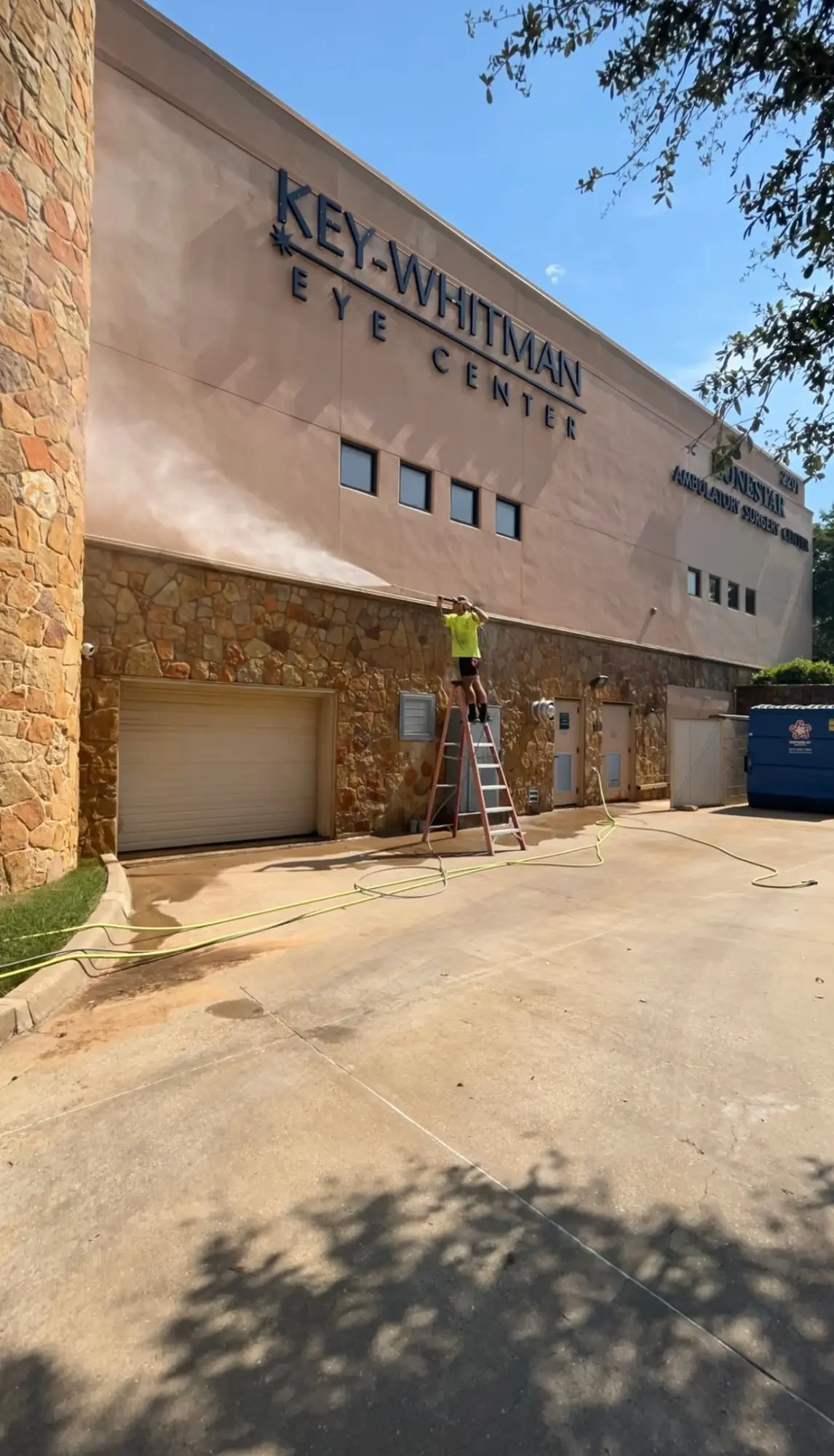
Curb appeal matters, but the real reason to schedule cleaning is operational. A dock apron slick with oil is a safety incident waiting to happen. A truck court coated in rubber deposits wears tires faster and tracks debris into the building. A dumpster pad that smells keeps tenants calling. Regular cleaning removes those liabilities on a predictable cadence so they never become emergencies. I saw this firsthand at the Key-Whitman building in Grapevine, where years of buildup on the exterior had become a tenant complaint. After we cleaned it, the property manager added us to their preferred vendor list.
Here is a recommended cleaning frequency for each warehouse zone, based on what we see across DFW properties:
Zone | Recommended Frequency | Why |
|---|---|---|
Dock aprons and truck courts | Quarterly | Heavy diesel, hydraulic fluid, and rubber buildup from daily traffic |
Building elevations (tilt-wall, metal panels) | Every 6-12 months | Algae on shaded sides, roof-drain streaking, and splash lines |
Dumpster pads and back-of-house | Monthly to quarterly | Grease, odor, and pest attraction that routine sweeping misses |
Drive lanes and parking areas | Every 6 months | Gum, oil drips, and embedded dirt that degrade striping |
Covered walkways and arcades | Every 6-12 months | These never get rinsed by rain and collect grime steadily |
The High-Priority Areas on an Industrial Property
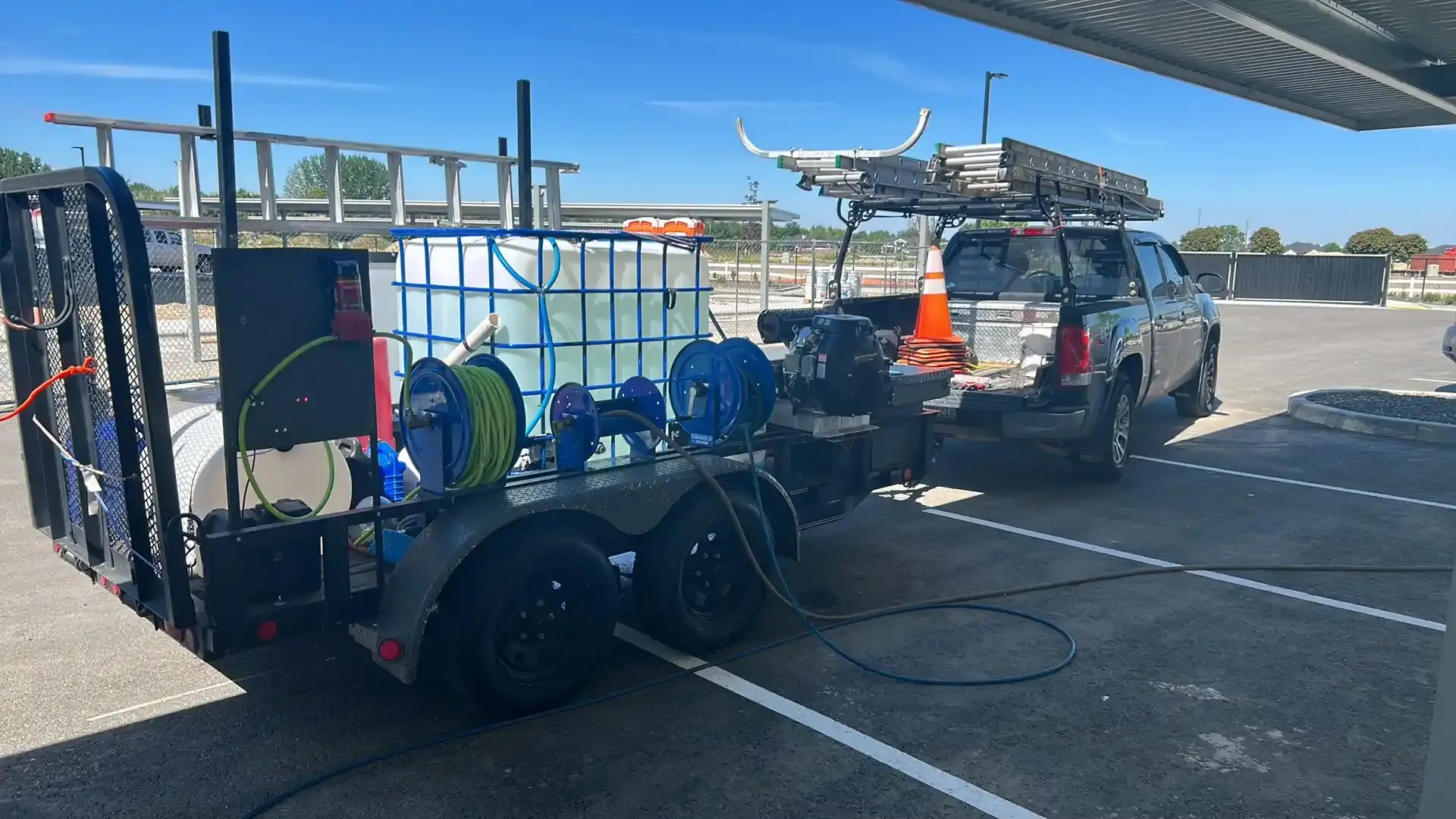
Not every square foot of a warehouse exterior needs the same treatment. Some zones require chemical pretreatment and low pressure. Others need the full force of a surface cleaner. Knowing which is which is what separates a surface-level rinse from a clean that lasts.
Every property we handle gets the same three steps. First, we match the cleaner to the surface so dirt and algae release on their own. No blasting at full power and hoping for the best. Second, we apply low pressure carefully. That keeps paint, signage, metal panels, and landscaping safe. Third, we rinse everything down and walk the property with you. We pack up when you are satisfied, not before. Those three steps apply whether we are working on a dock apron, a tilt-wall panel, or a covered walkway.
On a recent project at the Bank of Texas location in Grapevine, the building exterior had years of grime that masked the original finish. We pretreated the shaded elevations where algae had taken hold, then worked section by section with low pressure so the signage and glazing stayed protected. The before-and-after difference was immediate, and the branch staff noticed it before we finished the final walkthrough.
Loading Dock Pressure Washing and Dock Aprons
Loading docks take the worst of what a warehouse dishes out. Forklifts leak hydraulic fluid. Trailers drip oil. Tires lay down rubber that bakes into the concrete under the Texas sun. Over time, the apron turns dark and slick, and the stains travel up the dock levelers and into the bays.
Cleaning a dock apron properly means breaking down the oil and grease before any pressure touches the surface. Pressure alone pushes the contamination around and drives it deeper into the concrete. We apply a degreasing solution matched to the stain type, let it dwell, then rinse with a surface cleaner that delivers an even pass without gouging the slab. The same approach works for bay oil, ramps, and stairwells in parking decks, where buildup collects in the corners and gets ignored by routine maintenance.
Here is what a dock-focused cleaning targets:
- Bay oil, ramps, and stairwells in parking decks
- Diesel, hydraulic fluid, and rubber on truck courts and trailer parking
- Gum and spills on entry sidewalks and drive-thru lanes
A clean dock apron is easier to inspect, safer for forklift operators, and less likely to draw a citation during a site audit. At the Bank of Texas location in Grapevine, the dock area had years of grime that masked the original finish. We pretreated the shaded elevations where algae had taken hold, then worked section by section with low pressure so the signage and glazing stayed protected.
Trailer and Truck Courts
Truck courts are the workhorses of a warehouse property, and they show every mile. Heavy vehicle traffic compresses dirt, rubber, and fluids into the asphalt and concrete until the surface looks permanently stained. The challenge is not just the volume of traffic. It is that the court cannot be shut down for a full day while someone cleans it.
We phase the work in zones so the shipping team always has a clear dock door. On a typical warehouse project, we section the court into thirds. We close one zone at a time and coordinate the schedule with the dock manager. The flow of trucks never stops. The cleaning itself follows the same three-step process. We apply a pretreatment to break down diesel and rubber deposits. Then we use a low-pressure rinse that does not splash product onto parked trailers. A final walkthrough confirms every zone is dry and open before we move to the next.
Can we work around your dock schedule? Yes. That is the whole point of phasing. We have cleaned courts while the overnight sort was running on the other side of the building, and the shipping team never lost a door. On a project at Dallas Medical Center, we phased the truck court cleaning so the loading dock stayed open for supply deliveries the entire shift. For a distribution center pressure washing project, this kind of coordination is what keeps operations moving.
Drive Lanes, Parking Areas and Oil Stains
Drive lanes and parking areas collect a different kind of grime. Gum, spills, and oil drips from employee vehicles mark the asphalt and concrete in ways that a sweeper truck cannot touch. Gum, in particular, needs individual treatment. Chasing spots with a wand leaves a ring of clean concrete around every piece. We treat gum spots one at a time with a targeted solution before the surface cleaning begins, so the whole area comes up even.
Routine parking lot cleaning and striping go hand in hand. A lot that is cleaned regularly holds its striping longer because the paint is not ground down by embedded dirt. For warehouses that share a lot with retail or office tenants, a clean parking area signals that the property is managed, not neglected. We also handle post-construction cleanup when a new build or renovation leaves behind dust and debris that standard sweeping misses. Usman Shams, a recent client, told us after we cleaned his driveway and patio: "Really happy with the work Gem Pro Exterior Solutions did today. Everything came out looking great." The same gum and oil treatment process we used on his residential hard surfaces applies directly to commercial drive lanes.
Here is what we address in drive lanes and parking:
- Gum and spills on entry sidewalks and drive-thru lanes
- Routine parking lot cleaning and striping
- Oil stains that have set into the asphalt over multiple seasons
Will gum actually come off? In most cases, yes, when it is treated individually before the main cleaning pass. Some older stains may leave a faint shadow if they have been baking in the sun for years, but the surface will be clean and the color even.
Metal Panels, Canopies and Building Exteriors
Vertical surfaces on a warehouse present a different set of risks. Painted tilt-wall panels, metal canopies, and glazed facades can all be damaged by high pressure. The question I hear most often from facility managers is whether pressure will damage painted tilt-wall panels. It can, which is why panels are soft washed rather than blasted. We use a professional-grade sodium hypochlorite-based cleaner, dwelled for 10 to 15 minutes, so the solution does the work. The rinse stays low pressure. The streaking comes off, and the paint stays on.
Roof-drain streaking and splash lines on tilt-wall and metal panel buildings are a common sight in Dallas. Rainwater channels dirt down the same path every storm, leaving vertical stripes that stand out against the rest of the elevation. Those streaks respond well to a soft-wash pretreatment followed by a low-pressure rinse. The same approach applies to canopies, covered walkways, and arcades that never get rinsed by rain. Andi Boren, who managed the Key-Whitman building in Grapevine, saw the result firsthand: "The before and after photos were phenomenal." That kind of outcome comes from matching the method to the surface, every time.
Flatwork is the opposite. That is where real pressure belongs, delivered through a surface cleaner for an even pass. Knowing the difference is what keeps a building exterior looking clean without introducing new problems. This is the kind of warehouse exterior cleaning Dallas TX properties need to stay presentable year-round.
How Gem Pro Works Around Your Shipping Schedule
A warehouse does not close for cleaning. The trucks keep moving, the docks stay busy, and the facility manager needs the work done without disrupting operations. Here is how we make that happen:
- Site walk and dock audit. I walk the property with the dock manager to map out zones, identify high-traffic periods, and mark areas that need pretreatment.
- Zone phasing plan. We divide the cleaning into zones that keep at least one dock door per section open at all times. The plan is shared with the shipping team before we start.
- Pretreatment during off-peak hours. We apply cleaning solutions when truck traffic is lightest, often in the early morning or late evening, so the dwell time does not interfere with operations.
- Low-pressure rinse and immediate drying. Each zone is rinsed and squeegeed so it is safe to walk and drive on as soon as we finish.
- Final walkthrough and sign-off. I walk the property with you or your designated lead, zone by zone, and we do not pack up until you confirm every area meets the standard.
Can we clean before you open? Yes. Can we work outside business hours? Yes. We schedule around your peak times, not ours. On a recent multi-building project, we phased the truck court cleaning so the overnight sort team never lost a dock door, and the day shift arrived to a clean, dry court with no downtime. This is the kind of reliability that makes us one of the commercial pressure washing companies Dallas facility managers call when they need the job done right.
Safety, Stormwater and Site Compliance
Facility managers carry a lot of liability, and an exterior cleaning vendor should reduce that load, not add to it. We are locally owned and carry full commercial insurance. Before we start any job, we review the site for stormwater drains, landscaping, and pedestrian paths so the rinse water is managed and contained.
What happens to the runoff in the yard? We use professional-grade solutions designed for exterior cleaning and follow proper application and rinsing practices to protect surrounding landscaping and surfaces. Runoff is directed away from storm drains where possible, and we adjust our methods based on the site layout and any local requirements the property manager flags.
Here is a quick look at the compliance factors we address on every industrial site:
- Environmentally safe solutions: We use professional-grade cleaners applied at the correct dilution for the surface and rinsed with care around landscaping and drains.
- Insured operations: We carry commercial insurance, and we can provide a certificate before work begins.
- Site-specific planning: Every job starts with a walkthrough that identifies drains, sensitive areas, and pedestrian paths so the plan fits the site.
- Weekend and after-hours availability: We schedule around your operations so cleaning never disrupts active shifts.
What to Expect From a Warehouse Quote
A warehouse pressure washing Dallas quote should be transparent and based on what is actually on the ground. When you request a quote from us, here is what happens. We call you back within 24 hours[1] of the submitted request. Then we schedule a site walk so I can measure the square footage, assess the surface types, and note the degree of staining. Those three factors drive the scope and the price: a tilt-wall building with light streaking costs less to clean than a dock apron saturated with years of hydraulic fluid.
After the walkthrough, you receive a line-item quote that breaks out each zone and the cleaning method we recommend. No hidden costs, no surprises. The quote includes the phasing plan if your site needs it, so you know exactly how we will work around your schedule before you sign anything. For a deeper look at what drives pricing, see our commercial pressure washing cost guide for DFW.
Why Dallas Facility Managers Choose Gem Pro
Facility managers in DFW have options for exterior cleaning, and the ones who stick with us tend to value two things: communication and follow-through. They want a vendor who shows up when they say they will, explains what the crew is doing, and does not leave until the job is right.
Ariyana Ann, who was working at one of the Bank of Texas locations when we cleaned the building exterior, saw that process firsthand. The crew arrived on schedule, worked methodically around the branch hours, and left the elevation looking like it had just been painted. That kind of result comes from treating every property with the same care we would give our own, which is how we approach every warehouse, medical facility. Retail plaza we clean across the Greater Dallas - Fort Worth Metroplex.
When you manage a high-value property, the exterior is the first thing your tenants, drivers, and clients see. Keeping it clean is not a luxury. It is part of protecting the asset. We make that part of your job easier by handling the cleaning on a schedule that fits your operations, with a process you can see and a result you can walk before we leave. If you also manage parking areas, read how we handle parking lot pressure washing in Dallas. For a broader look at our commercial work, see our commercial exterior cleaning services in Fort Worth.
If you manage a warehouse or industrial property in Dallas, the exterior does not have to be a constant headache. A scheduled cleaning program keeps your dock aprons safe, your truck courts presentable, and your building elevations free of the streaking and algae that build up season after season. The work fits around your shipping schedule, and you get a walkthrough before we leave so you know exactly what was done. Request your warehouse pressure washing Dallas quote and we will call you back within 24 hours[1] to set up a site walk.
Frequently asked questions
How often should a warehouse exterior be washed?
Most warehouses benefit from a full exterior cleaning once or twice per year, depending on traffic volume and exposure. A distribution center with heavy truck traffic may need dock aprons and courts cleaned quarterly, while building elevations can often go six to twelve months between washes. We help you set a schedule based on what we see during the site walk, so you are not paying for cleanings you do not need or skipping ones you do.
Can you handle several buildings in a park?
Yes. We clean multiple buildings on the same campus under one coordinated plan. The work is phased so each building stays operational while we move through the park. Invoicing can be consolidated or split by building, whichever the property management office prefers.
Will pressure damage painted tilt-wall panels?
It can, which is why we soft wash panels instead of using high pressure. The cleaning solution lifts the streaking and grime, and the rinse stays low pressure so the paint stays intact. Flatwork like concrete aprons and drive lanes is where we use real pressure, delivered through a surface cleaner for an even, safe pass.
Can you work around our dock schedule?
Absolutely. We phase the cleaning in zones so you always have a clear dock door. The phasing plan is built during the site walk and shared with your shipping team before we start. We also schedule pretreatment and rinsing during off-peak hours so the flow of trucks never stops.
What happens to the run-off in the yard?
We use professional-grade cleaning solutions and follow proper application and rinsing practices to protect landscaping and surfaces. Runoff is directed away from storm drains where the site layout allows, and we adjust our approach based on any local requirements you flag during the walkthrough.
Can a whole campus go on one invoice?
Yes. We can consolidate billing for multiple buildings on a single campus into one invoice, or split it by building if your accounting requires separate cost centers. We set that up before work begins on your warehouse pressure washing Dallas project so there are no surprises on the back end.